
This second article in a two-part series focuses on chemical and thermal compatibility in industrial cartridge filtration. However, the tenets in this document are not limited to industrial cartridge filtration and can be applied to other filtration and separation equipment.
Chemical compatibility and thermal compatibility are not independent of each other. In fact, they are very much dependent on each other and need to be considered collectively.
Following is a list of common chemical and thermal compatibility considerations an application engineer should consider when designing a system. This is an abbreviated list of common considerations and is not all-inclusive. Each application, type of filtration equipment, the regional environmental conditions and corporate and/or governmental regulations might require additional considerations. For example, filtration processes frequently require start-up and shutdown procedures that have different operating conditions from the operating conditions of the filtration process.
Some examples to take into consideration are:
- Shipping and Storage
- What is the ambient temperature of the region in which the filtration process will occur? For example, some thermoplastic materials (e.g., polypropylene) become brittle in colder temperatures.
- Will the filter or filtration system be exposed to severe temperatures, humid or corrosive conditions in transport and storage? Humidity can cause corrosion of metal components.
- Start-up
- Prior to starting the filtration process, the filtration system might need to be flushed with a different fluid and/or temperature than the process fluid.
- The components of a filter will be at ambient temperature during installation. When the process fluid is introduced to the filtration system, is there potential for thermal shock? Each material has its own coefficient of thermal expansion, and if a filter has different materials of construction, the materials will expand or contract at different rates, which could potentially compromise the filter (e.g., adhesive can separate from end caps).
- Filtration Operations
- Fluid processes can be one singular fluid, a homogenous mix of fluids or separate phases of fluids. If the stream is a mix of fluids, which is most commonly the case, compatibility with all fluids the filter and wetted parts of the filtration vessel will contact must be considered in addition to anticipated exposure time to these fluids at operating conditions.
- Is the fluid process intermittent or continuous? If intermittent, to what fluid and temperature will the filters be exposed when the vessel is on standby? Chemical attack and corrosion rates can increase in static fluids.
- Shut Down
- In some cases, the fluid being filtered is hazardous (e.g., contains H2S, HCN or Ethylene Oxide, among others), so plant operations will require procedures to remove any health, environmental or safety hazards prior to filter change-outs to avoid environmental release or operator exposure to these hazards. Some examples are flushing with non-process fluids that can have different chemical and thermal compatibility with the filter materials of construction or purging the system with either gas (e.g., nitrogen) or steam. Depending on the steam pressure, the temperatures can well exceed operating temperature of the process. Elastomeric seals, potting materials, filter media fiber/binder materials and thermoplastics used in filter construction can be incompatible with steam at these elevated temperatures.
Chemical and thermal compatibility of singular fluids can be found in literature or chemical compatibility guides, but the information in these guides can be limited, unclear or contradictory, making selection challenging. And chemical compatibility guides do not provide information on mixtures, often only provide compatibility at ambient temperature and seldom disclose exposure duration. Therefore, chemical compatibility guides should only be used as a general guide. When dealing with uncommon fluids, mixtures or nonambient temperatures, it is recommended to conduct soak tests. A soak test involves soaking each component of the filter in the process fluid at the process conditions (i.e., fluid mixture, operating temperature, system pressure) for the anticipated exposure time.
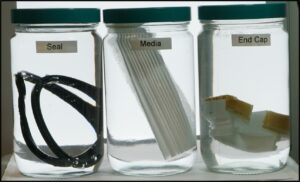
Examples of soak testing of various materials
Ideally, the soak test is done in the process, but it also can be conducted in a laboratory under a controlled environment to mimic the actual process conditions. The sample filter material and the process fluid can be placed in a reactor and tested at operating conditions (temperature and pressure).
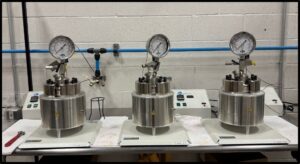
Examples of reactors for soak testing
The material being tested can be visually inspected, photographed, measured and weighed prior to soaking for comparison to post-soaking conditions. Change of shape, change of mass, change of rigidity/elasticity, change of filter size, change of media burst strength, change of color of material and/or process fluid due to leaching of material composition, pre- and post-soaking foam testing of fluid and signs of corrosion are some of the parameters that can be measured to evaluate compatibility. Small changes in these may or may not be problematic for the process. The level of stability of filter components required is application dependent. With a good understanding of the process and filtration goals, a suitable material or combination of materials can be selected to ensure successful filtration. This is why it is imperative that all operating conditions and all environmental exposure conditions are considered when designing a filter or filtration system.
