Size Distribution and Sources of Particles in Ambient Air

Particle Size and Distribution in Ambient Air
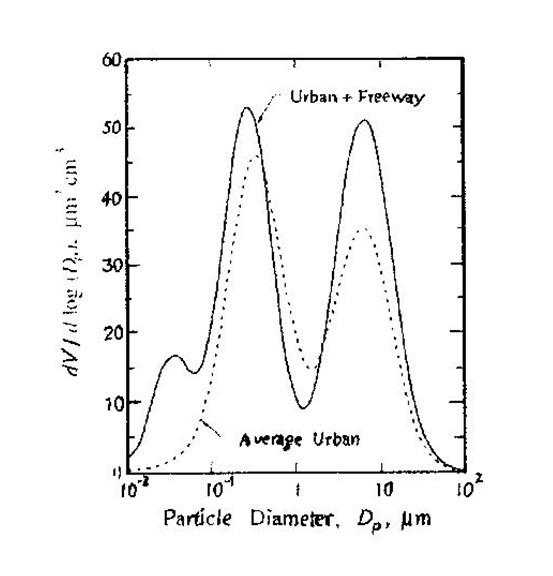
The particle sizes in the ambient air are ranged from 1 nanometer to slightly more than 10 micrometers. There are three modes: coarse, fine and nano. The course mode particles are road dusts, spores and pollens. The minimum sizes of these particles are 1 to 3 micrometers. The fine mode particles are generally secondary particles formed from reactions such as smoke, sulfates, nitrates, ammonium and lead. The minimum sizes of these particles are about 0.1 micrometers. Following Steinfeld & Pandis in 1998, a typical example of the size (volume) distribution of the urban & freeway is attached below.
Sources of Ambient Air Particles
EPA establishes air quality standards to protect public health, and also sets limits to protect public welfare including plants and animals, from harm, as well as protecting against decreased visibility and damage to crops, vegetation, and buildings. The followings are six common air pollutants:
- nitrogen dioxide (NO2),
- ozone (O3),
- sulfur dioxide (SO2),
- particulate matter (PM),
- carbon monoxide (CO), and
- lead (Pb)
Ozone is formed when oxides of nitrogen (NOx) and volatile organic compounds (VOCs) react in the presence of sunlight.
There are 12 major source sectors. The table below provides more detail about which sources are included in each sector.
12 Major Source Sectors | Detailed Category Names |
Fertilizer & Livestock | Livestock Waste |
Fertilizer Application | |
Electricity Generation | Fuel Combustion – Electric Utilities |
Fossil Fuel Combustion | Fuel Combustion – Industrial Boilers, Internal Combutions Engines |
Fuel Combustion – Commercial/Institutional | |
Fuel Combustion – Residential Fossil | |
Residential Wood Combustion | Fuel Combustion – Residential Fireplaces |
Fuel Combustion – Residential Woodstoves | |
Waste Disposal | Waste Disposal |
Waste Disposal – Open Burning | |
Fires | Wildfires |
Prescribed Fires | |
Agricultural Field Burning | |
Logging Slash Burning | |
Industrial Processes | Industrial Process – NEC |
Commercial Cooking | |
Industrial Process – Metals | |
Industrial Process – Chemical Manufacturing | |
Industrial Process – Storage & Transfer | |
Industrial Process – Petroleum Refineries | |
Industrial Process – Oil & Gas Production | |
Industrial Process – Pulp & Paper | |
Industrial Process – Cement Manufacturing | |
On Road Vehicles | On-Road Vehicles – Gasoline |
On-Road Vehicles – Diesel | |
Non Road Equipment | Non-Road Equipment – Gasoline |
Non-Road Equipment – Diesel | |
Planes, Trains, & Ships | |
Road Dust | Unpaved Roads |
Paved Roads | |
Solvent Use | Solvent – Non-industrial |
Surface Coating – Industrial | |
Degreasing | |
Surface Coating – Architectural | |
Graphic Arts | |
Solvent – Not Classified Elsewhere | |
Dry Cleaning | |
Miscellaneous | Agriculture – Crop Tilling & Livestock Dust |
Construction | |
Gas Stations | |
Bulk Gasoline Terminals | |
Other Miscellaneous Sources |
(EPA)
Particulate Matter (PM): The major source of PM10 is road dust and secondly source is miscellaneous. For PM2.5, there are various sources including road dust, miscellaneous, industrial processes, electricity generation, any combution related, waste disposal and vehicles.
Volatile organic compounds (VOCs): The sources of volatile organic compounds (VOCs) emissions are solvent use, vehicles, industrial processes, miscellaneous, any combustion related, and waste disposal.
Sulfur dioxide (SO2): The major source of SO2 is electricity generation and fossil fuel combustion and industrail processes are 2nd and 3rd sources, respectively.
Nitrogen oxides (NOx): The sources of nitrogen oxides emissions are vehicles, electricity generation and fossil fuel combustion, industrial processes and waste disposal.
Lead (Pb): The sources of lead emissions are off-highway vehicles, industrial processes, fossil fuel combustion, waste disposal and electricity generation.
Carbon monoxide (CO): The sources of carbon monoxide are vehicles and any combustion related.
Author
Kyung-Ju Choi
University of Louisville Louisville, Kentucky 40292, USA
Tags
