Precision Monofilament Woven Filtration Media

Precision woven monofilament filtration fabrics can be classified many ways and into several broad categories, usually by their micron rating, fractional void volume, specific weight or application, such as filtration or dewatering. Monofilament yarns might be recognized by their use in fishing or weed-trimmer line; however, filtration media requires greater precision in weaving and therefore a much different class of yarn. Precision woven monofilament fabrics for filtration and dewatering applications fall into three popular ranges of weight per square yard of finished fabric: 1) 1 to 5 ounces, 2) 8 to 15 ounces, and 3) 30 ounces and above.
Because of their advantageous mechanical properties, polyester and nylon are the most common polymers used in the production of monofilament yarns. Polypropylene, polyethylene, E-CTFE and PVDF follow at a distance. Occasionally, carbon yarns are interwoven in monofilament constructions to bleed off static electricity where the danger of static build-up and unpredictable discharge is an issue. The nominal diameters of monofilament yarn size range from 0.001” (25 microns) up to 0.040” (1,000 microns) and are very consistent over length, except for polypropylene which is difficult to extrude and spin without variation in diameter. Woven monofilament fabrics tend to be stiff, especially above 3 – 4 ounces per square yard. This rigidity is often an asset when used in applications like insert-molded filters, belting, sifter screens and self-supporting pleats.
Fine diameter monofilament yarns (0.001”) are woven with a yarn count up to 600 yarns per inch in both the warp (machine direction) and fill or weft (cross-machine direction). These high-count textiles generally have a media rating on the order of 10 microns. With post-calendering, this aperture rating can be further reduced to approximately 5 microns with a very narrow size distribution. Fine calendared fabrics perform well as backpulse liquid filter elements and rotary drums used to dewater solids. Heavy fabrics are constructed using the 0.040” (1,000) micron diameter yarns and have a finished fabric weight up to 40 – 50 ounces per square yard. Dewatering belts for municipal sludge represent a common application for such fabrics. Other belts are constructed of two interwoven fabric layers, making a single composite having a under-belt fabric for load bearing purposes and a fine screen on the top layer facing the feed stream.
Monofilament fabrics have important attributes. They can be woven very precisely with narrow pore size distributions. As a result, they are commonly rated and referred to as surface-retentive, absolute-rated filter media. In plain weave constructions, monofilament fabrics have straight- through pores (holes), thus providing minimal flow restriction and surface loading of particles. Twills and Dutch weaves provide excellent surfaces for cake release where needed. These weaves offer only a mildly torturous open path, so their use does not significantly restrict flow.
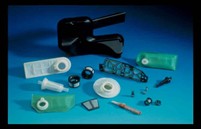
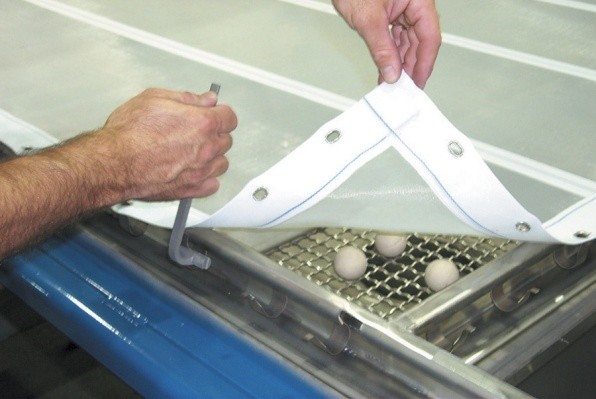
Approximately half of the market includes air and fuel filter cartridges on commercial and military aircraft and appliance filters, such as those used as lint collectors in residential and industrial laundry dryers and the permanent screens in coffee maker filters. In transportation, monofilaments are widely used as filters in automotive gas tanks, fuel injector nozzles and transmission pans. In healthcare, they serve in diagnostic test kits, blood filters used in open-heart surgery, burn patient therapy beds, and wound dressings. The second half of the market revolves around the industrial process industries. Uses include sifting screens for abrasives, pharmaceuticals, kaolin, grains and powders. Monofilament fabrics are common found on rotary drum filters, chamber presses and dewatering belts. The belt market includes many diverse applications ranging from municipal sludge dewatering to chemical processing to food products, such as corn gluten. These fabrics are widely used as liquid filter bags to strain paint and coatings as well as cylindrical sleeves in rotary sifters. Additional applications include coal sector bags, fluidized beds and fish screens in aquaculture.
Tags
