
The global shift to renewable energy sources continues to increase rapidly which has resulted in a resurgence of the biofuel industry. With new government mandates and tax incentives, biofuel producers are investing in re-starting production and plant expansions. In addition, significant investments are being made in upgrading/modifying existing refinery processes to use bio-based feedstocks producing renewable diesel. The new mandates are also pushing the blending of fuels with biofuels increasing the blending operations at the fuel terminals.
 The most common way to produce biodiesel is by the transesterification of triglycerides present in feedstock oils like canola oil, soybean oil, or animal fats. Renewable diesel production uses these same feedstock oils, but these are typically fed to an existing hydrotreater unit in a refinery. In both processes, water is used or produced and consequently needs to be removed from the final product. When blending biodiesel and diesel, water typically
precipitates and must also be removed from the final blended product before it can be used. Water will cause corrosion in storage tanks and increased microbial growth resulting in off-spec products.
High efficiency liquid/liquid coalescers provide an efficient, low energy consuming, low maintenance, low-cost option for water removal from biofuels or fuel dehazing. In biodiesel production, the fuel is typically water washed to remove water soluble contaminants. The resulting fuel will contain approximately 5-10% water. The biodiesel then enters a vacuum dryer where the dissolved water is removed to meet the final required specification. Currently, the fuel specification for biodiesel is a max of 500 ppm of water. This is below the solubility limit of water in biodiesel (~1500 ppm at room temperature). Since biodiesel is hygroscopic and will readily absorb moisture, the final product typically will need to be stored under a nitrogen blanket.
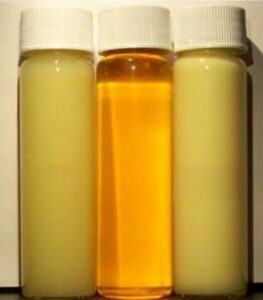
High efficiency liquid/liquid coalescers were tested to remove water after the water wash in 18 biodiesel production sites. On average 97%
of total water was removed. The figure on the left shows the feed/inlet stream to the coalescer, the outlet biodiesel stream, and the water/soap layer removed.
More recently, the high efficiency liquid/liquid coalescers were employed at 2 refinery sites that were modified to process bio-based feedstocks producing renewable diesel. The bio-based oils were pre-treated and fed to a
hydrotreater. The coalescers were then used to remove moisture or haze from the renewable diesel final product.
The result was a bright and clear fuel meeting the required specifications.
Lastly, the coalescers were also tested at a terminal that was blending 5% biodiesel with petroleum diesel (B5). After blending, the blended fuel had significant amounts of undissolved water that was found at the bottom of the storage tanks. The coalescers were tested and the effluent blended fuel contained < 15 ppm of free water.
In conclusion, water or haze removal is necessary when producing biodiesel, renewable diesel, and blended fuels.
High efficiency coalescers provide an optimal solution to remove the moisture and produce on-spec biofuel products.
