
The demand for dry tests to verify mechanical integrity of finished modules in membrane manufacturing across the globe is becoming of vital importance. Historically, membrane manufacturers opted for a test that involved a solute marker or just water which then requires further treatment to eliminate solute traces, drying product using natural or forced drying techniques or utilize a preservative solution that limits microbial growth within the finished product. This was due to lack of confidence in the dry test or unavailability of a test conclusive enough to release a product.
Common types of dry tests that are used within and outside the membrane manufacturing industry are the positive pressure decay tests or the vacuum decay test. The underlying concept in these tests is to measure the rate of pressure loss or rate of vacuum loss and identify an acceptable rate that ensures mechanical integrity of the product. Integrity tests are designed around the evaluation of the quality of the seal that separates the feed stream from the product stream, because the quality of the seal defines the quality of the product stream. A major challenge in designing a dry test is quantifying the amount of pressure loss or vacuum loss via natural diffusion through the membrane material itself which needs to be discounted from the total pressure loss or vacuum loss of the system. It is important to note that the test system design, test specifications and pass/fail criteria will depend on the membrane product to be tested and the diffusional properties of its components which makes it a unique test for each system.
 During test validation, one needs to design and perform a series of fully destructive tests using a colored test marker such as a dye (preferably under a pressurized environment) and/or a semi-destructive test using bubble point leak test method. A wide range of product test samples should be chosen for evaluation with each having a different pressure loss or vacuum decay rate. In case of the pressurized dye test, every sample should be autopsied and inspected for any dye passage through the seal. However, in the case of the bubble leak test, one should look out for a continuous or periodic stream of bubbles from the area of inspection. Indication of no distinct dye passage or lack of any continuous stream of bubbles indicate a good quality seal. A correlation between the leak rate and defect identification should help optimize the leak test specification.
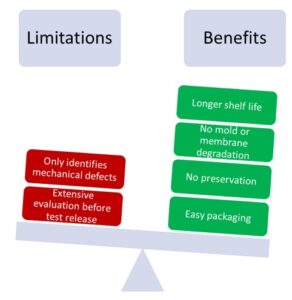
Dry tests do come with its own set of limitations such as inability to detect membrane surface defects, identify functional flaws, non-conformity in the product structure or utilization of incorrect components. These defects can be identified or evaluated by performing product sampling or batch tests using a standard test designed for the respective product.
Therefore, dry tests come with benefits like increased shelf life, eliminate mold growth or product degradation, eliminate usage of preservative liquid, eliminate non-value-added post treatment, and simplifies product packaging requirements.
