Filter Aid Permeability Test Method

Permeability is a measure of rate of liquid flowing through a porous medium or a particulate filter cake. It is an important characteristic that filter aid manufacturers use in their product specification. Currently in the US, there has not been a standard filter aid permeability test method. Companies use own standards for filter aid product specifications.
There are two methods in permeability determination: the liquid flowing through already formed cake approach (Method I) and the cake filtration approach (Method II). A detailed comparison of the two methods including test methods and fundamental basis is shown in the Table.
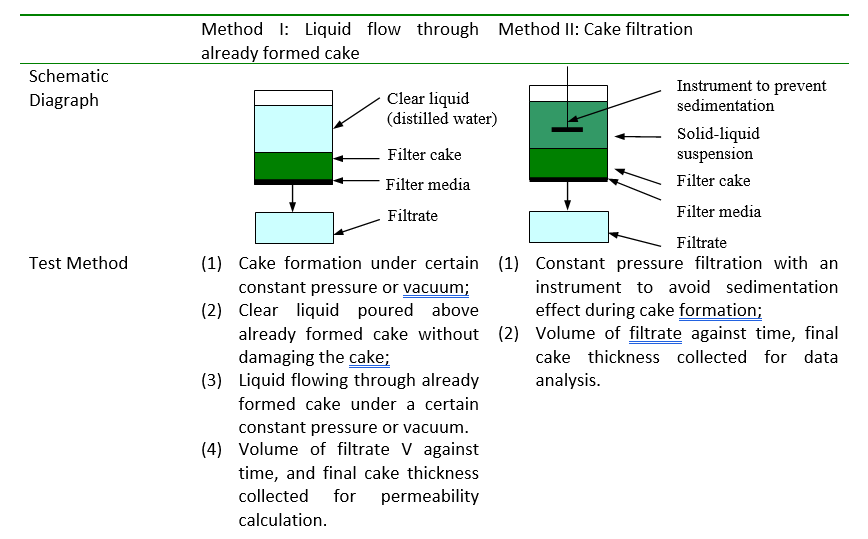
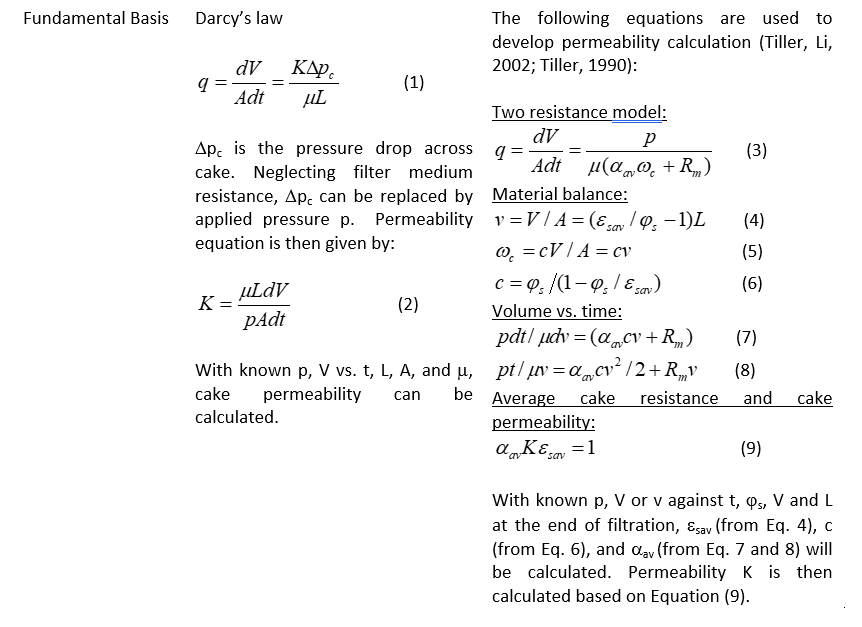
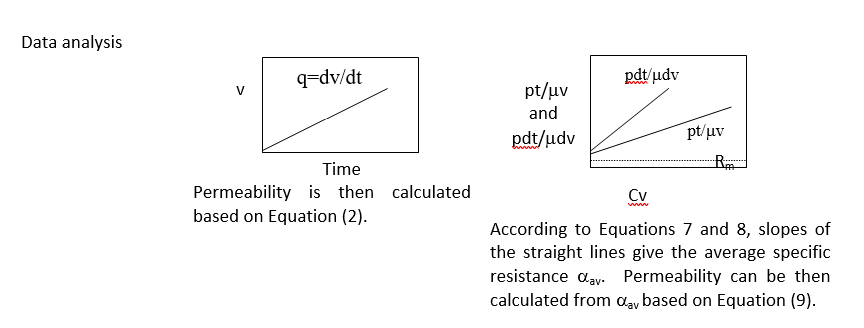
Permeability determined by the Method I depends upon how the filter cake is initially formed and how the liquid is poured on the top of filter cake without cake disturbance. Filter media resistance is not included in the cake permeability calculation. With a substantial media blinding and increase of filter media resistance, an error will occur for calculation of cake permeability without considerations of filter media resistance. It can be only used to determine permeability of incompactible material.
The Method II approach is based on fundamental filtration theory (Tiller, 1990, 2002) assuming there is no effect of sedimentation during cake formation, and a parabolic volume of filtrate vs. time curve. The equipment and calculations are more complicated. However, it include filter media resistance, and gives dynamic permeability during cake formation period under constant pressure, or varying pressure tests. It can be also used to test cake permeability or filterbility of solid-liquid suspensions including highly compactible materials.
References
Tiller, F. M., and W. Li, Theory and Practice of Solid/Liquid Separation, Fourth Edition, 2002, University of Houston
Tiller, F. M., “Tutorial: Interpretation of Filtration Data, I”, Fluid/Particle Separation Journal, Vol. 3, 85-94, 1990
Author
Wenping works for Agrilectric Research Company on rice hull ash filtration product and technology, and new application development.
Tags
