
 eq. 3
eq. 3
 eq. 4
eq. 4
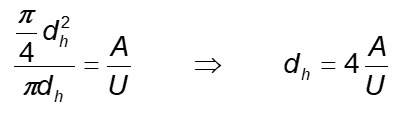
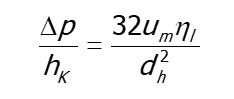
The geometrical characteristics of the packed bed are accounted for by the specific flow resistance rc. With eq. 2 – eq. 4 this yields the mean hydraulic diameter.
 eq. 5
eq. 5
In contrast to the single-phase flow during e.g. cake formation, during deliquoring or under-saturation interfacial tension effects need to be considered. Between two immiscible fluids an interface is formed. To increase the interfacial area energy is required. This energy is called interfacial or surface tension gL. The interfacial tension compensates the pressure difference in the two phases. This results in a curved boundary. The pressure difference is called the capillary pressure. By convention it is established that the capillary pressure is pK>0, when the denser phase has an over pressure and pK<0 when the in the denser phase has a under pressure.
Applied to a pore with solid walls (three phase), this means the effective capillary pressure at the interface between liquid and gas needs to be overcome by an externally applied potential (e.g. pressure gradient, centrifugal force etc.). This can also be explained by a force balance according to Figure 2.

Figure 2 : Force balance around interface
For a wetting liquid (d <90 °), which has not yet reached the capillary equilibrium height, due to surface tension it results a gravity opposing force which leads to an increase in liquid level up to the capillary equilibrium height hK. In the equilibrium state, lift weight of the liquid column and capillary force equal exactly. The angle formed between the vessel wall and the liquid is called wetting angle d. By convention pL<pG leads to a positive capillary pressure pK.
For a non-wetting liquid (d> 90 °) a negative capillary pressure results, i.e. the capillary is emptying without pressure gradient. At (d = 90 °) the capillary pressure pK equals 0.
For a spherical boundary under consideration of the capillary radius r the force balance results in most common form of the Laplace equation.
 eq. 6
eq. 6
With increasing pore radius the capillary pressure of a wetting liquid and thus the capillary rise is smaller.
It follows that when applying a pressure differential, the first large capillaries are drained and those whose capillary pressure pK£Dp. Characteristic for the deliquoring is the occurrence of so-called “fingering”, i.e. a premature drainage of larger pores compared to plug flow. After emptying the largest pore a gas breakthrough occurs and hence the collapse of the driving pressure difference. In centrifugal dewatering this does not occur. Further deliquoring can be realized only by enormous compressor performance. Depending on the external pressure difference and the pore size distribution therefore only a proportion, namely from the pores with pK£Dp, of liquid can be removed.
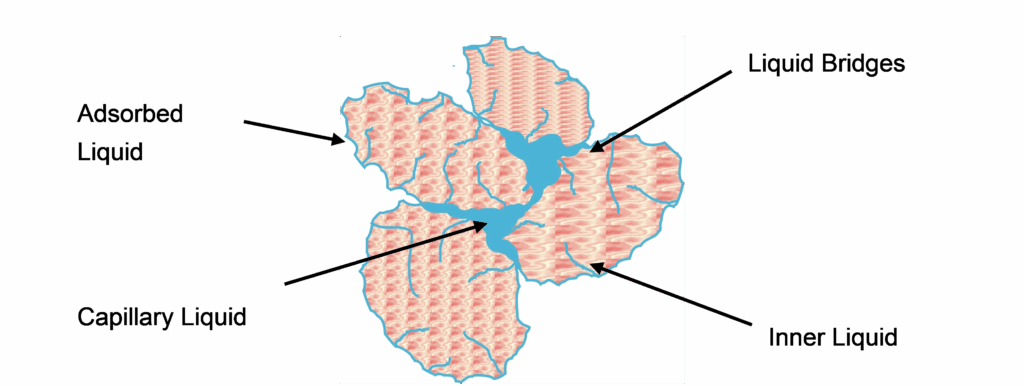
Liquid bridges, adsorbed or adhesive liquid and inner liquid are difficult to access with gas pressure difference. By means of capillary pressure, it is possible to make predictions about the dewaterability of a product, but not the kinetics of moisture removal.
All of the above is also transferable to the processes carried out during pore size distribution measurement by for instance a PMI type instrument.
