
Viscosity is a measure of the flowability of a fluid. It is measured in Pa.s The greater the viscosity, the more viscous and less flowable is the fluid, the lower the viscosity, the thinner and more flowable it is. It is usually associated with the term shear viscosity, but it can also be associated with elongation viscosity.
Molecules in viscous liquids are strongly bound to each other and thus not freely moveable, one speaks also of the internal friction. It results from the attractions between the molecules of the fluid (cohesion, van der Waals forces, hydrogen bonding etc.).
The effect of internal friction is easier to imagine by the motion of two superimposed, interlocked molecular layers. During flow, the molecules slide past each other. This requires a certain force. The relationship between this force and the properties of the fluid is defined as the shear viscosity.
The underlying principle for determining of the viscosity is the model of a moving plate gap. Resulting from the movement of the plates, the individual layers of liquid move at different speeds, resulting in a velocity gradient:

Newtonian Fluids
In the following simplified relationship according to Newton’s law of viscosity, it is assumed to have laminar flow and temperature and pressure independence of the fluid properties. Newton also assumed a linear dependence of the velocity gradient discussed above. This gradient is also called shear rate. Linked this with the shear stress τ, we obtain the following relationship for the dynamic viscosity:
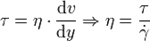
The shear stress τ arises from the force causing the flow relative to the affected area, which moves at maximum speed. The viscosity η is regarded as a constant in Newtonian fluids. Furthermore, the relationship between the dynamic viscosity η and density ρ is defined as the kinematic viscosity.
kinematic viscosity: |  | dynamic viscosity: |  |
Non-Newtonian Fluids
Many substances, however, do not follow this law, but also show a time or shear rate-dependent behavior. A distinction is made between different types of deviation:
- Thinning / Dilatancy: While the viscosity η is not constant but varies with the shear rate.
- Thixotropy / Rheopexy: This is showing time-dependent structural changes, so that depending on the length of time since the last motion other viscosity values are found.
- Yield stress: It must be a certain minimum shear stress available to achieve a flowing (plastic flow). This kind of fluid is also known as Bingham fluid.
Such fluids are called non-Newtonian fluids.
 | Shear stress-shear rate diagram: 1: Dilatant fluid |
The viscosity has a major influence on separation equipment, since it determines drag and friction forces during particle settling and filtration. The viscosity of water for instance varies by a factor of two between 20C and 50C potentially leading to higher settling rates or improved filtration kinetics.
