Fundamentals of Gas Filtration: Particle Capture Mechanisms

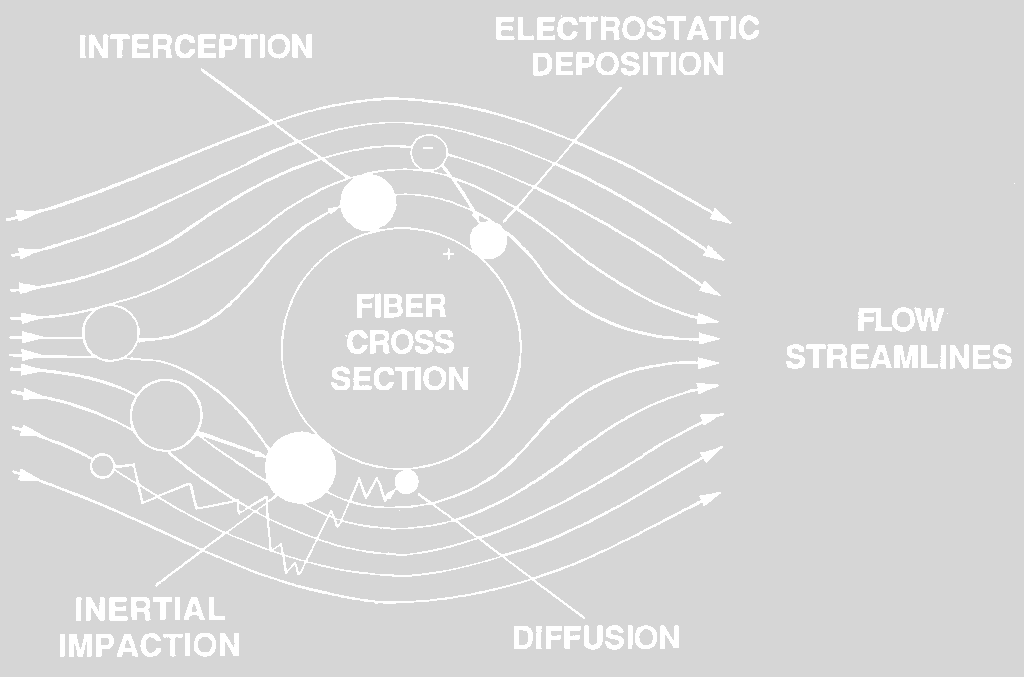
Understanding the ability of filter media to collect particles from a gas stream passing through it is key to the successful filter design and selection. Particles are captured within the depth of a porous media as the gas follows a tortuous flow path created by the series of interconnected void spaces formed by the micro filter structure (e.g., fibers, membrane, etc). Each time the gas stream flow around the micro structure, or though a porous opening, particles have an opportunity to deposit onto the structure primarily by the capture mechanisms shown in the attached illustration. As the gas flows around the structural elements, particles can be primarily removed from the gas stream via the particle collection mechanisms of diffusion, interception, inertial impaction and electrostatic deposition. Lesser importance mechanisms include sieving and gravitational sedimentation. The particle capturing effectiveness of each mechanism is primarily dependent on the particle size, gas velocity and size of the filter structure (e.g., fiber diameter).
Diffusion
Particle deposition via diffusion results when particles collide with the filter structure due to their random Brownian motion. This random motion (zigzag path) occurs when small particles collide with gas molecules, thereby altering the particle trajectory around the filter structure. This motion, and hence the degree of particle capture, becomes more pronounced as the particle diameter becomes smaller, especially for particles less than 0.1 m
Interception
A particle is deposited via the interception mechanism if a particle of finite size is brought within one particle radius of the filter structure as it follows the flow streamlines around the filter structure. Collection via this mechanism increases with increasing particle size. Interception becomes the dominant capture mechanism for particles in the 0.1 to 1 m and larger size range.
Inertial Impaction
Larger particles collide with the filter structure due to the mechanism of inertial impaction, as the particles are unable to follow the curve path of the gas streamline around the filter structure. Particles deviate from their initial fluid streamline, due to their inertia (finite mass), as the gas curves to flow around the filter structure. This mechanism becomes an increasingly significant means of particle collection for larger particles (particle mass), and higher gas velocities. This mechanism becomes important for particles larger than 0.3 to 1.0 m, depending on the gas velocity and filter structure size.
Electrostatic Effects
Particles deposit via electrostatic deposition if electrical charges on either the particle or the filter, or both, create attractive electrostatic forces of sufficient magnitude to attract the particle to the filter surface.
Gravitational Sedimentation
Large particles (i.e., larger than 10 m), at relatively low velocities, can be captured via gravitational sedimentation if sedimentation causes the particle to deviate from its original path and come into contact with the filter structure.
Sieving
Particles unable to pass through openings in the filter structure, due to their larger size, are captured via the mechanism of sieving. While this mechanism is operable in gas filtration, particles capable of being captured via sieving usually are captured via interception or inertial impaction before they can be captured via sieving.
Author
Ken Rubow
Tags
